
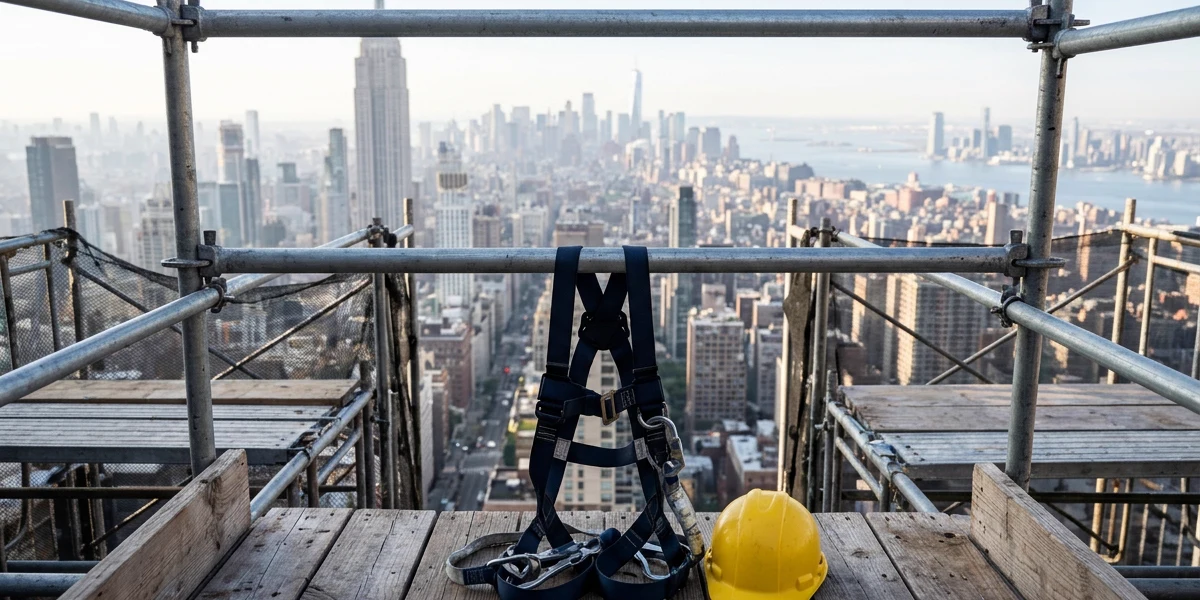
Year after year, falls from heights remain the leading cause of death and catastrophic injury on construction sites in New York City, from high-rise projects in Manhattan to home renovations in Staten Island, Brooklyn, and the other boroughs. A worker who falls from a scaffold, a ladder, or an unguarded edge, or who is struck by material falling from above, rarely walks away with a minor injury. Often these workers are subject to fractured spines, traumatic brain injuries, shattered limbs, and lost lives.
New York answers that reality with the strongest worker protection statute in the country: Labor Law § 240(1), often referred to as the Scaffold Law. It places a non-delegable duty to protect workers from gravity-related dangers squarely on owners and general contractors, and it holds them strictly liable when they fail. For injured workers and their families, it is often the difference between financial ruin and a full recovery of their losses.
Unfortunately, this statute, whose mission is to safeguard workers, is under threat. Fresh off enacting sweeping changes to car accident law in the 2026 budget, Governor Hochul is widely expected to target the Scaffold Law next, in the state budget due early in 2027. This guide explains what the law is, who it protects, why these cases are among the strongest in New York personal injury law, and where the political fight stands.
What this guide covers
- What Is New York Labor Law 240(1)?
- What Labor Law 240(1) Covers
- Strict Liability and the Non-Delegable Duty
- A Worker's Own Negligence Is Not a Defense
- The Workers' Compensation Trap, and Why 240(1) Matters So Much
- The Defenses Owners and Contractors Raise
- Why Labor Law 240(1) Cases Demand Experienced Counsel
- The Political Fight: Labor Law § 240(1) and the 2027 Budget
- Compensation in New York Labor Law 240(1) Cases
- Speak With a New York Construction Accident Lawyer
- Frequently Asked Questions About New York's Scaffold Law
What Is New York Labor Law 240(1)?
Labor Law § 240(1) requires owners and general contractors to furnish and properly place the safety devices that protect workers from elevation-related risks: scaffolding, hoists, ladders, slings, ropes, braces, pulleys, and other protective equipment, so as to give workers proper protection. The statute's roots reach back to 1885, when workers were dying on New York building sites with no recourse, and its purpose has never changed: the people who control construction work, and profit from it, must bear the responsibility of making it safe, because the worker on the ladder controls neither the equipment he is given nor the site he is given it on.
Courts apply the statute to the gravity-related dangers of construction work, in two directions: the worker who falls, and the object that falls on the worker. When a required safety device is absent, defective, or inadequate, and that failure causes an elevation-related injury, the statute is violated.
What Labor Law 240(1) Covers
Falls From Heights
The classic Labor Law § 240(1) case is a worker who falls from an elevated height because the device meant to hold him failed or was never provided: a scaffold without guardrails, a ladder that shifts or collapses, a plank that gives way, an unguarded floor opening, a roof edge with no protection, an elevated platform with no harness or anchorage point. The height of the fall does not need to be dramatic. What matters is that the work exposed the worker to an elevation-related risk and the statutorily required protection was not there.
Falling Objects
The statute's second branch protects workers struck by objects that fall because they were inadequately hoisted or secured: a load that slips from a sling, material that drops from a hoist, equipment that falls from an elevated work area.
What Is Not Covered
Precision matters, because defendants exploit the edges of the statute. The law protects workers engaged in the erection, demolition, repairing, altering, painting, cleaning, or pointing of a building or structure. Routine maintenance, such as changing a lightbulb or performing ordinary upkeep that is not repair work, generally falls outside of the protections of the statute. So do injuries with no elevation component. And the statute exempts owners of one- and two-family homes who do not direct or control the work, so a worker injured renovating a private house may need to proceed under different legal theories. Whether a given job qualifies is frequently the central battle in the case, fought through the fine details of what the worker was actually doing, and it is a battle that rewards lawyers who know the case law cold.
Strict Liability and the Non-Delegable Duty
Two features make the Scaffold Law unlike anything else in New York tort law.
First, liability is strict. In an ordinary negligence case, the injured person must prove the defendant failed to act reasonably. Under § 240(1), the question is simpler and more powerful: was the statute violated, was the work being performed covered work, and did the violation cause the injury? If the answer is yes, the owner and general contractor are liable as a matter of law. In many of these cases, experienced counsel can win liability outright on a motion for summary judgment, before trial ever begins, which transforms the case into a dispute only about the amount of compensation.
Second, the duty is non-delegable. Owners and general contractors cannot escape responsibility by pointing at the subcontractor who supplied the ladder or the site safety company they hired. The duty to provide proper protection stays with them no matter how many layers of contractors stand in between, and no matter whether they ever set foot on the site. The law deliberately places responsibility at the top, where the power to demand a safe site actually lives.
A Worker's Own Negligence Is Not a Defense
Here is the feature that makes Labor Law § 240(1) truly singular, and the one its opponents attack most fiercely: comparative negligence is not a defense to a § 240(1) claim. In nearly every other kind of New York injury case, a defendant can reduce its liability by blaming the victim, and juries routinely shave recoveries by whatever percentage of fault they assign to the injured person. Not here. Once a statutory violation is established as a proximate cause of the injury, the worker's recovery is not reduced because he could have climbed more carefully or positioned the ladder differently.
The Legislature made that choice deliberately. Workers do not choose their equipment, their deadlines, or their sites, and a law that let owners cut their responsibility in half by blaming the man they failed to protect would gut the protection entirely. The contrast with where the rest of New York law is heading makes the point sharper: in 2026, New York rewrote its car accident laws so that a crash victim found more than half at fault recovers nothing at all. Construction workers under the Labor Law retain something far stronger, which is precisely why the statute is now in the political crosshairs, as discussed below. Only where the evidence demonstrates that the worker was the sole proximate cause of the accident can the owner and general contractor escape liability.
The Workers' Compensation Trap, and Why 240(1) Matters So Much
Most injured construction workers learn two hard truths in quick succession. The first is that workers' compensation is their only remedy against their own employer: the law bars employees from suing the company that hired them, no matter how negligent it was. The second is that workers' compensation does not come close to covering the real losses of a serious injury. It pays a fraction of lost wages, nothing for pain and suffering, and nothing for the life a catastrophic injury takes away.
Labor Law § 240(1) is the answer to that trap. Because the statute imposes liability on the owner and the general contractor, who are usually not the injured worker's direct employer, it opens a separate, third-party lawsuit that workers' compensation does not bar. That lawsuit is where full compensation lives: all lost earnings and benefits, past and future, including the union wages, annuity contributions, and pension losses that define a construction career, together with complete medical costs and full pain and suffering damages. A worker can collect workers' compensation benefits and pursue the Labor Law case at the same time. For a tradesperson whose injuries end a career decades early, the difference between the two can be measured in millions of dollars.
The Defenses Owners and Contractors Raise
Strict liability does not mean defendants surrender. Their insurers litigate these cases hard, and their favorite weapon is the sole proximate cause defense: the claim that adequate safety devices were available, the worker knew it, was expected to use them, and chose not to for no good reason, making his own conduct the only cause of the accident. A related version, the recalcitrant worker defense, argues the worker defied an explicit instruction to use protection that was provided.
These defenses fail far more often than they succeed, but defeating them takes evidence: proof of what equipment was and was not actually on site, who directed the work, what instructions were really given rather than what a site safety manual claims, and what the practical realities of the job demanded. Witness statements from coworkers, site photographs, equipment logs, safety meeting records, and accident reports all vanish or harden into the defense's version of events within days. The investigation that wins a Labor Law § 240(1) case starts immediately, not after the insurance company has had months to shape the record.
One more deadline hides in these cases: when the project is a public one, on property owned by the City, a public authority, a school construction authority, or another government entity, the claim may require a notice of claim within 90 days of the accident, the same unforgiving deadline that governs other claims against public entities in New York. Construction workers on public projects should never assume they have years to act.
Defendants also defend these cases by attacking the damages claims, disputing the severity of the injuries, the need for future medical care, and the extent of the worker's lost earnings.
Why Labor Law 240(1) Cases Demand Experienced Counsel
New York Labor Law litigation is a specialty, and the gap between adequate and excellent representation shows up directly in the result. These cases are won with the right experts: engineers who reconstruct the failure, site safety professionals who establish what proper protection required, physicians who prove the full extent of the injuries, and economists and life-care planners who quantify a lifetime of lost earnings and future care. They are won by lawyers who move for summary judgment aggressively, who know every covered-activity and sole-proximate-cause precedent, and who prepare every case for trial, because insurers pay trial value only to firms they know will try the case.
Grandelli & Eskenasi's history shows what that means in practice. In one case that drew statewide attention in legal circles, the firm represented a New York City plumber who was shocked by an uninsulated wire while working on a ladder and fell. Whether the accident was covered by § 240(1) at all was litigated through New York's appellate courts, all the way to the Court of Appeals, the state's highest court. At a mediation, the defense made a "final offer" of $1.5 million. The offer was rejected and the firm established the defendants' liability and settled the case the day before trial for $7,250,000, nearly five times that final offer. (Prior results do not guarantee a similar outcome.) The difference was not luck; it was the willingness and ability to litigate hard questions to the end.
The Political Fight: Labor Law § 240(1) and the 2027 Budget
For as long as Labor Law § 240(1) has existed, the insurance and construction industries have campaigned to weaken it, arguing that strict liability inflates insurance premiums and construction costs. Bills to repeal the statute or dilute it with comparative fault have been introduced in Albany session after session, and the Legislature has rejected every one, recognizing that the law's costs fall on those best positioned to prevent injuries and that its protections save lives on the most dangerous worksites in America.
The fight is now entering a new phase. In the 2026 budget, Governor Hochul demonstrated a willingness to use the budget process to enact tort reform that had long stalled in the Legislature, eliminating an entire category of serious injury claims and imposing a new fault bar in car accident cases. With that package enacted, reform advocates have made no secret that the Labor Law is the next target, and Albany reporting in the fall of 2026 described legislative sources bracing for a Scaffold Law battle in the coming budget cycle. The Governor won re-election in November 2026, and her executive budget proposal is due by February 1, 2027.
Workers and their families should understand two things clearly. First, nothing has changed yet: as of today, Labor Law § 240(1) remains fully in force, strict liability and all, and no proposal to amend it has been enacted. Second, the possibility of change is real in a way it has not been before, and the direction of any change would be one way only: against injured workers. If the Labor Law fight does reach the budget table in 2027, the arguments will be the same ones the Legislature has rejected for decades, and this firm will be watching, and advocating, on the side of the workers the statute was written to protect. We will update this analysis when the executive budget is released.
For anyone injured now, the practical takeaway is simpler: claims are governed by the law in effect when they are brought, and a worker injured today should assert his rights under today's law without delay.
Compensation in New York Labor Law 240(1) Cases
Because construction accidents so often involve catastrophic injuries to workers in their prime earning years, these cases carry some of the largest recoveries in New York personal injury law. Compensation can include the full measure of medical expenses, past and future; lost earnings and benefits across what would have been an entire career, including union wages, overtime, annuity and pension contributions; the cost of future care for permanent injuries; pain and suffering; and, in fatal cases, wrongful death damages for the worker's family, an area in which the firm achieved a precedent-establishing recovery for the family of a 43-year-old construction worker killed as a result of a fall from a ladder.
The firm's construction accident results rank among the highest on record in New York, including a $22.9 million recovery for a construction worker catastrophically injured in a worksite explosion, a case in which the firm obtained summary judgment under the Labor Law against defendants represented by twelve opposing law firms. In 2026 alone, the firm's recoveries include construction accident results of $7.75 million, $6.5 million, and $5.5 million. (Prior results do not guarantee a similar outcome.) Numbers like these reflect what the Labor Law makes possible when cases are investigated thoroughly, litigated aggressively, and prepared for trial from day one.
Speak With a New York Construction Accident Lawyer
Since 1992, Grandelli & Eskenasi has fought for injured construction workers and their families, recovering hundreds of millions of dollars and earning a statewide reputation in Labor Law litigation, including cases argued through New York's highest court. We represent workers across every trade, union and non-union alike, on projects throughout Manhattan, Staten Island, Brooklyn, Queens, the Bronx, and the State of New York.
If you or a loved one has been injured in a fall from a height or by a falling object on a construction site, your rights under the Labor Law are powerful, but they are not self-executing. Evidence disappears quickly, deadlines can be as short as 90 days on public projects, and the political ground under the statute itself may be shifting. Contact us for a free consultation at our Manhattan, Staten Island, or Brooklyn office.
Frequently Asked Questions About New York's Scaffold Law
What is Labor Law 240(1), the New York "Scaffold Law"?
It is the New York statute requiring owners and general contractors to provide construction workers with proper safety devices, such as scaffolds, ladders, hoists, and harnesses, to protect against elevation-related risks. When the required protection is absent or inadequate and a worker is injured by a fall or a falling object as a result, the owner and general contractor are strictly liable.
Does it matter if the accident was partly my fault?
No. Comparative negligence is not a defense to a Scaffold Law claim. Once a violation of the statute is established as a proximate cause of the injury, the worker's recovery is not reduced by his own alleged carelessness. The main exception is the sole proximate cause defense, where defendants must prove adequate safety devices were available and the worker unreasonably chose not to use them, a defense that thorough investigation usually defeats.
Can I sue if I am already receiving workers' compensation?
Yes. Workers' compensation bars a lawsuit against your own employer, but a Labor Law claim is brought against the property owner and general contractor, who are typically separate entities. You can collect workers' compensation benefits and pursue the Labor Law case at the same time, and the lawsuit is where full compensation for lost earnings, future care, and pain and suffering is recovered.
Are ladder falls covered by the Labor Law?
Yes, falls from ladders are among the most common Labor Law 240(1) cases, along with falls from roofs, platforms, and unguarded openings, and injuries from inadequately hoisted or secured objects that fall and strike workers below.
Who is not protected by Labor Law 240(1)?
The statute protects workers performing construction, demolition, repair, alteration, painting, cleaning, or pointing of a building or structure. Workers performing routine maintenance generally are not covered, and owners of one- and two-family homes who do not direct or control the work are exempt. Whether a particular job qualifies is often the key disputed issue, so a worker should never assume they are uncovered without a legal evaluation.
Is New York repealing Labor Law § 240(1)?
No. As of today, Labor Law 240(1) is fully in force and nothing has been enacted to change it. However, after the 2026 budget rewrote New York's car accident laws, the Governor is widely expected to propose limiting the Labor Law in the state budget due by February 1, 2027. Any change would face a Legislature that has rejected such proposals for decades. Workers injured now should assert their rights under current law promptly.
How long do I have to file a Labor Law claim?
Generally three years from the accident, but with a critical exception: when the project involves a public owner, such as the City, a public authority, or a school construction authority, a notice of claim may be required within 90 days. Because construction sites often involve public entities in ways workers do not realize, the safest course is to have the deadlines evaluated by an attorney immediately.