
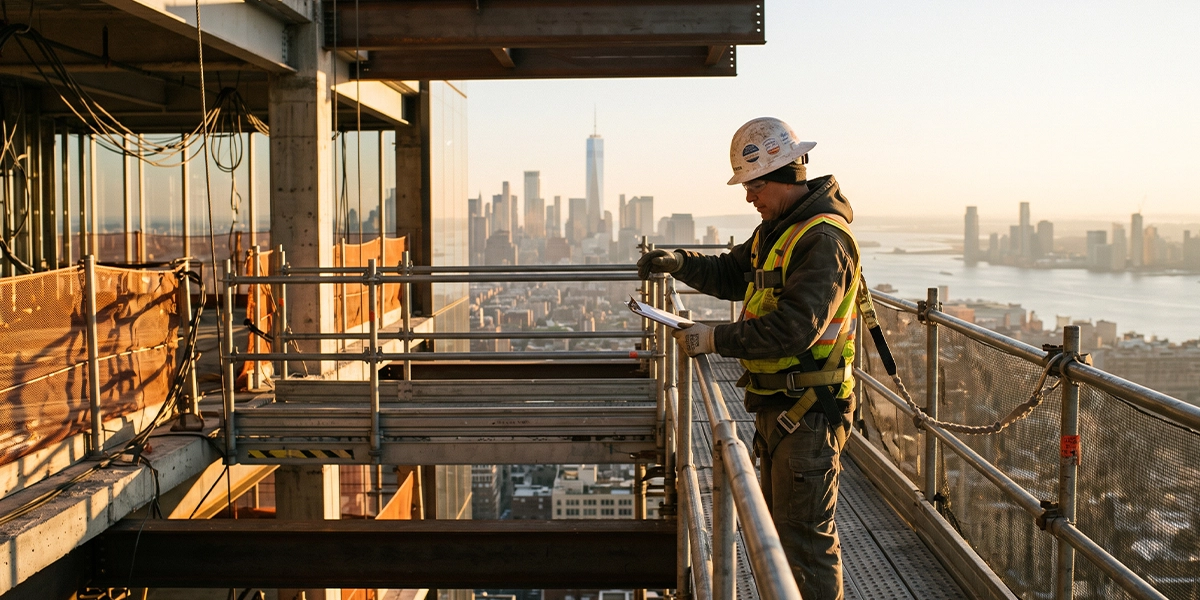
Construction is a way of life in New York City. It seems like everywhere you go, there is an ongoing construction project somewhere in your field of view. While this construction work is critical for housing, commercial business and even industrial business, it is important to remember that construction work can be dangerous. Falls from ladders and scaffolds, falling objects, defective equipment, unsafe walking surfaces, electrical hazards, and inadequate safety equipment are just some of the hazards that construction workers face each day on the job. All too often, these accidents lead to injuries that have devastating lifelong effects.
Fortunately, New York has several statutes providing construction workers with significant legal protections. Namely, New York Labor Law §§ 200, 240 and 241 place various duties on both employers and property owners alike to provide safe conditions for construction workers.
What This Guide Covers
What to Do After a Construction Accident
If you or a loved one is injured in a construction accident, the first step should be to seek medical attention. Construction accidents can be very serious, and some injuries may not become apparent until hours or days after the accident itself, so it is critical to be examined by a medical professional as soon as possible. After receiving medical attention, take the following steps:
1. Report the Accident
After receiving medical attention, the next step is to report the accident to the appropriate site personnel as close in time to the accident as possible. This may be to the foreman, superintendent, or site safety employee on site. The report should be as accurate and precise as possible, describing where the accident occurred, how the accident occurred, and should identify any equipment or conditions that caused the accident.
2. Document the Scene of the Accident
When possible, document the scene of the accident by taking photographs and videos of where the accident occurred and any equipment involved. Be sure to document any temporary conditions that may have caused the accident, including but not limited to construction debris, a wet surface, or defective equipment.
3. Identify Witnesses
Witnesses, such as fellow coworkers at the site at the time of the accident, may provide crucial evidence for litigation. This can include witnesses who observed the accident, or witnesses who observed a dangerous condition prior to the accident occurring. It is important to identify witnesses as soon as possible, as they may be hard to identify later on.
4. Preserve Equipment and Other Evidence
Any equipment involved in the accident can also serve as important evidence during litigation. Equipment that was involved in the accident, including ladders, scaffolds, harnesses, power tools, or other devices should be preserved so that they can be inspected, and any defects documented. It is also important to preserve documents generated in connection with the work. Daily logs, safety meeting records, incident and/or accident reports, photos, videos, contracts, inspection records, permits, site safety plans and contractor communications are all important pieces of evidence to preserve for litigation.
5. Speak with an Attorney
While it is always a good idea to consult with an attorney after any accident, it is especially important for construction accidents. Litigation concerning construction accidents can be more complex than other accidents, often involving numerous potential defendants, among the property owners, contractors, and subcontractors, and may implicate one or more of New York's Labor Laws. If you or a loved one has been in a construction accident, it is important to consult with experienced attorneys, such as those at Grandelli & Eskenasi, to help guide you through this complex process.
Who May Be Liable for a Construction Accident
In construction accidents, it is particularly important to be diligent in identifying potential defendants. This is because a construction project may involve any number of property owners, contractors, subcontractors, architects, engineers, equipment suppliers, and other entities that may be liable for the accident. New York's Labor Laws place a duty on property owners and employers to maintain a safe work space, and provide certain safety equipment, to workers, and will be liable if they fail to do so. Property owners and employers may also be liable if they provide faulty safety equipment, as well as the equipment manufacturers and suppliers. Lastly, the City of New York, or other municipal entities, may be liable if they owned the property or have some other role in the project. If the City of New York or another municipal entity is a potential defendant, it is important to remember that a Notice of Claim must be served on that entity within 90 days after the accident occurred.
New York Labor Law §§ 200, 240 and 241
As a construction worker in New York, it is important to know the legal protections in place for you:
Labor Law § 200 is a codification of common law negligence and places a duty on property owners and contractors to construct, equip, arrange, operate, and conduct the work site in such a manner as to provide reasonable and adequate protection to lives, health, and safety of all persons employed at the site or lawfully at the site.
Labor Law § 240(1) places a non-delegable duty on property owners and general contractors to provide employees conducting work on elevated surfaces with safety equipment such as scaffolding, ladders, and other devices so that the employee may safely conduct work at that elevation. New York courts have also routinely held that property owners and employers have an obligation to provide safety equipment under Labor Law § 240 where objects falling from elevated heights pose a risk to workers on site. See Quattrocchi v F.J. Sciame Constr. Co., 11 NY3d 757 (2008).
Labor Law § 241(6) also imposes various duties on property owners and contractors regarding safety at construction and demolition sites. This section creates liability for violations of the New York Industrial Code, which is a series of safety requirements at a job site, designed to protect workers. The Industrial Code covers areas such as the flooring, doors, elevators, and general area at the site, as well as safety guidelines for tools.
Protecting Your Rights After a New York Construction Accident
At Grandelli & Eskenasi, we have represented seriously injured construction workers throughout New York for decades. Construction accidents can leave workers and their families in harrowing situations, often facing extensive medical bills, lost earnings, and long-term uncertainty. Understanding who was responsible and which New York worker-protection laws apply is an important first step toward protecting your rights.
If you or a loved one was seriously injured on a construction site in New York, contact Grandelli & Eskenasi to discuss your legal options.