
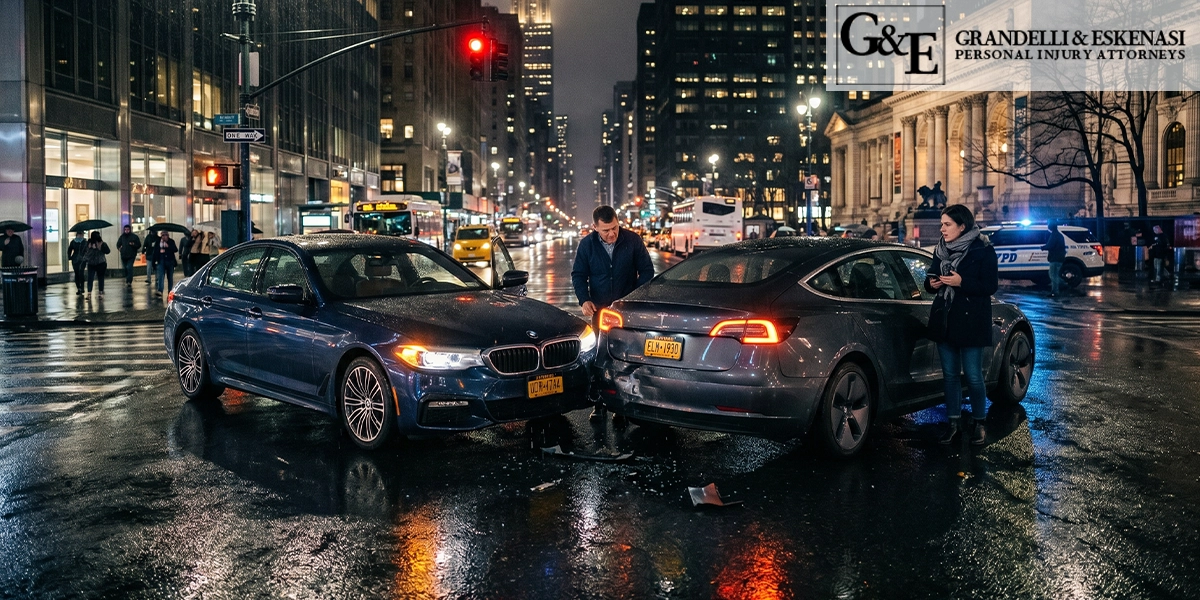
Rear-end collisions are among the most common crashes on New York roads. While many are low-speed, fender-benders, they can still cause injuries, significant repair costs, and create complicated insurance and liability issues. This post explains why rear-end collisions happen, how New York law treats them, steps to take if you’re involved, and practical tips to reduce your risk.
Common Reasons Why Rear-End Collisions Occur in New York
- Following too closely: Tailgating reduces reaction time when the lead vehicle slows or stops. The law in New York imposes a driver on all drivers to maintain a reasonably safe distance between the front of their vehicle and the rear of any vehicle in front of them based on the prevailing conditions (Vehicle and Traffic Law § 1129 [a]).
- Distracted driving: Phone use, eating, adjusting controls, and other distractions are major contributors. Notably, under most circumstances, New York law prohibits drivers from using a handheld mobile phone or a portable electronic device while operating a vehicle (Vehicle and Traffic Law §§ 1225-C and 1225-D).
- Speeding: Higher speeds increase stopping distance and the severity of impact.
- Sudden stops: Unanticipated braking by the lead vehicle — sometimes due to hazards, traffic, or merging — can cause a chain reaction.
- Weather and road conditions: Rain, snow, ice, and poor visibility lengthen stopping distances and reduce traction.
- Vehicle issues: Worn brakes, defective lights, or tire problems impair a driver’s ability to stop safely.
New York Law & Liability Basics in Auto Accidents
Presumption of fault: In New York, a driver who rear-ends another is presumed to be negligent and at fault in causing the accident, because drivers are expected to maintain a safe following distance and control of their vehicle. As such, when admissible evidence showing that a driver rear-ended the vehicle in front of him/her has been presented, the rear driver has the burden to come forward with a non-negligent excuse.
Notably, the fact that the lead vehicle suddenly stopped generally does not constitute a non-negligent excuse, because sudden and frequent stops are foreseeable under most prevailing traffic conditions.
In addition, a claim by the rear driver that he did not notice that the lead vehicle was braking until it was too late to come to stop before the collision generally will not constitute a non-negligent excuse, because New York law imposes a common-law duty on all drivers to see what there is to be seen through the proper use of his/her senses. In other words, drivers are expected to keep a reasonable lookout at traffic within view, and to take reasonable measures to avoid any potential collisions.
However, if, for example, the lead vehicle had suddenly switched lanes in front of the rear vehicle without properly signaling or when it was not safe to do so, giving the rear vehicle no time to react to avoid the collision, it may constitute a non-negligent excuse rebutting the presumption of negligence.
Immediate Steps After a Rear-End Collision in NYC
Safety first: Move to a safe location if possible, turn on hazard lights, and call emergency services if anyone is injured.
Call the police: A formal report helps with insurance claims and legal actions. In New York, call 911 for injury or significant property damage.
Exchange information: Get names, phone numbers, license plate numbers, driver’s license numbers, insurance company and policy numbers.
Document the scene: To the extent that it is safe to do so under the prevailing traffic conditions, take photos of vehicle damage, license plates, skid marks, road conditions, traffic signals, and relevant surroundings. Record witness contact information.
Seek medical attention: Some injuries aren’t immediately apparent. Keep records of medical visits and treatments.
Notify your insurer promptly: Provide factual information without admitting fault.
Preserve evidence: Keep repair estimates, medical bills, and any communication with insurers or other parties.
If you have sustained serious injuries as a result of the rear-end accident, you should promptly consult with an experienced New York personal injury attorney, like Grandelli & Eskenasi, as they can help evaluate liability, negotiate with insurers, and advise on suing for additional compensation if the injury meets New York’s legal “serious injury” threshold.