
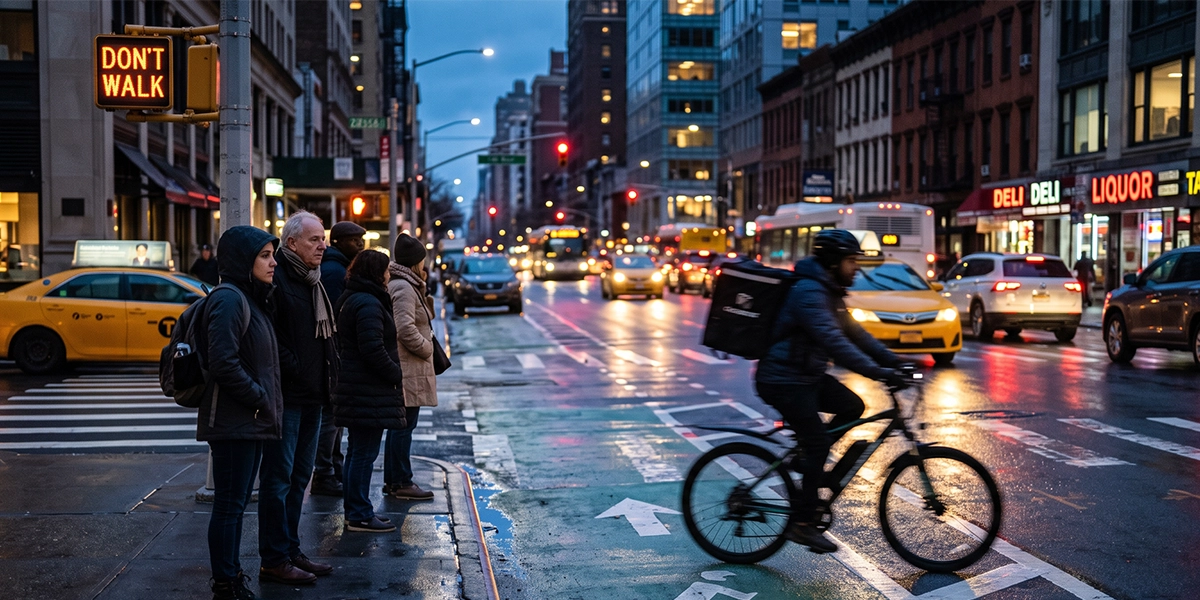
Electric bikes have transformed New York City's streets almost overnight. Delivery riders crisscross The Bronx, Manhattan, Brooklyn, Staten Island and Queens at all hours, commuters use pedal-assist bikes to skip the subway, and shared e-bikes are available on nearly every corner. The law, however, has not kept pace, and when an e-bike accident happens, victims are often shocked to learn that the rules they assumed would protect them simply do not apply.
The core problem is this: under New York law, an e-bike is generally not a "motor vehicle." That single classification decision ripples through every part of an e-bike injury case. It determines whether no-fault insurance pays your medical bills, whom you can sue, what you must prove, and where the money to compensate you will actually come from.
This guide explains how e-bike accident lawsuits work in New York City, whether you were injured while riding an e-bike or struck by one as a pedestrian.
What this guide covers
- E-Bike Laws in New York: The Basics
- The Insurance Gap: Why E-Bike Accident Claims Are Different
- Who Can Be Held Liable in a New York E-Bike Accident?
- Common E-Bike Accident Scenarios in NYC
- Why Early Investigation Decides E-Bike Accident Cases
- Compensation in E-Bike Accident Lawsuits
- Speak With a New York City E-Bike Accident Lawyer
- Frequently Asked Questions About E-Bike Accidents in New York
E-Bike Laws in New York: The Basics
New York legalized e-bikes statewide in 2020 and divides them into three classes. Class 1 bikes are pedal-assist only; Class 2 bikes have a throttle, and both are limited to 20 miles per hour. Class 3 e-bikes, which can reach 25 miles per hour, are permitted only in New York City. All three classes share something important: because they have electric motors below a certain power threshold and operable pedals, they are classified as electric-assisted bicycles rather than motor vehicles under the Vehicle and Traffic Law.
That means e-bikes unlike motorcycles, do not require registration, a driver's license, or, critically, insurance. Tens of thousands of e-bikes operate on New York City streets every day with no liability coverage behind them at all. When one of them causes a serious injury, that insurance gap becomes the central issue in the case.
The Insurance Gap: Why E-Bike Accident Claims Are Different
New York's No-Fault law was built around registered motor vehicles. Every car, truck, and taxi on the road must carry personal injury protection that pays medical bills and a portion of lost wages regardless of fault. E-bikes sit outside that system, and the consequences differ dramatically depending on which side of the accident you were on.
If You Were Riding an E-Bike and a Car Hit You
There is good news here. When a motor vehicle strikes an e-bike rider, New York law generally treats the rider much like a bicyclist or pedestrian, which means the rider can typically claim no-fault benefits from the striking vehicle's insurance policy. Those benefits can cover medical expenses and a portion of lost earnings, up to the policy limits, regardless of who caused the crash. Riders of Class 3 e-bikes occupy grayer legal territory, and coverage disputes are more common, which is one more reason to involve an attorney early.
Beyond no-fault benefits, a rider injured by a negligent driver can pursue a lawsuit against that driver for pain and suffering and other damages, just as an injured cyclist could. These cases are, at their core, bicycle accident claims with an added layer of insurance complexity, and they frequently involve the same fact patterns: drivers who fail to yield at intersections, doorings, and vehicles that turn across bike lanes without looking.
If You Were a Pedestrian Struck by an E-Bike
Here the gap works against the victim. Because the e-bike is not a motor vehicle, a pedestrian struck by one generally cannot collect no-fault benefits arising from the e-bike itself. There is usually no auto policy standing behind the rider at all. In some situations a victim may have other no-fault avenues, such as coverage under their own or a household member's automobile policy, but many victims, particularly those who do not own cars, have none.
Instead, the injured pedestrian must bring a negligence lawsuit directly against the rider and anyone else legally responsible. That makes two questions urgent from day one: who is the rider, and what sources of recovery exist beyond the rider personally? Answering those questions is what separates a compensable case from a dead end, and it is where an experienced counsel earns their keep.
One point works in the pedestrian's favor. New York's serious injury threshold, which limits pain and suffering claims arising from motor vehicle accidents, generally does not apply to a claim against an e-bike rider, precisely because no motor vehicle was involved. Victims should understand both edges of this sword: fewer insurance benefits on the front end, but fewer statutory barriers to a full recovery on the back end.
Who Can Be Held Liable in a New York E-Bike Accident?
The E-Bike Rider
A rider who speeds, runs a red light, rides against traffic, weaves onto the sidewalk, fails to yield to a pedestrian in a crosswalk, or is otherwise negligent in causing the accident, can be held personally liable for the injuries they cause. The practical challenge is collection. Many riders carry no insurance and have limited assets, which is why the investigation cannot stop with the rider.
Delivery Companies and Employers
A large share of e-bike accidents in New York City involve riders working at the time of the crash. When that is the case, the rider's employer may be held vicariously liable for the rider's negligence, and a restaurant, courier service, or delivery platform such as DoorDash, Uber Eats, or Grubhub may become a defendant with real insurance and real assets behind it. These companies often contest whether the rider was truly their employee or agent, and app-based platforms structure their relationships with riders specifically to resist these claims. Proving the employment relationship, through app data, delivery records, uniforms, and the rider's own statements, is frequently the decisive battle in the case.
Negligent Motorists
When a car or truck causes an e-bike crash, the driver and the vehicle's owner are liable under ordinary negligence principles, and the vehicle's insurance provides both no-fault benefits and liability coverage. Even in accidents that seem to involve only the e-bike, a motorist's conduct, such as an illegally parked truck forcing a rider into traffic, can create liability.
The City of New York
Some e-bike accidents are caused not by any rider or driver but by the road itself: a crumbling bike lane, a dangerous pothole, missing signage, or a defective roadway design. In those cases the City or another public entity may be liable, and the special rules that govern claims against government entities apply, including a strict 90-day deadline to serve a notice of claim. Anyone whose accident may involve a roadway defect should speak with an attorney immediately, because that deadline is far shorter than most people expect.
Manufacturers and Retailers
When a crash is caused by the e-bike itself, such as brake failure, a throttle that sticks, or a frame or component that breaks under normal use, the manufacturer, distributor, or retailer may be liable under New York product liability law. Preserving the bike in its post-accident condition is essential in these cases, because the defective component is the single most important piece of evidence.
Common E-Bike Accident Scenarios in NYC
Certain fact patterns come up again and again across the five boroughs:
- Pedestrians struck in crosswalks by riders who fail to yield or run signals, often at busy Manhattan and Brooklyn intersections
- Sidewalk collisions, since riding e-bikes on sidewalks is generally prohibited, yet remains common, and sidewalk victims are disproportionately older New Yorkers
- Wrong-way riding in bike lanes and on one-way streets, which limits pedestrians' and drivers' opportunity to anticipate the rider
- Doorings and failure-to-yield crashes that injure e-bike riders, particularly along avenue bike lanes
- Delivery riders under time pressure, whose speed and route choices are shaped by the economics of app-based delivery work
Because e-bikes are fast and nearly silent, victims often never see the impact coming, and the injuries, especially to pedestrians, can be severe: fractures, head trauma, and traumatic brain injuries are common even at moderate speeds.
Why Early Investigation Decides E-Bike Accident Cases
Unlike a city bus, an e-bike has no onboard camera, no event data recorder, and often no license plate. The evidence that wins these cases lives elsewhere, and it disappears quickly:
In hit-and-run scenarios, or where a rider gives incomplete information at the scene, identification depends on immediate canvassing for video and witnesses. A rider who is never identified usually means a claim that can never be brought.
Storefront cameras, building entrances, and traffic cameras capture most city intersections, but retention periods are short, sometimes only days. Preservation demands must go out fast.
If the rider was working, the delivery platform's records can establish the rider's identity, route, speed, and the fact that they were on an active delivery. Obtaining that data requires knowing what to demand and how to demand it before it becomes harder to reach.
Where a defect is suspected, the e-bike must be preserved and inspected before it is repaired, discarded, or altered.
Photographs, debris, and bystander accounts fix the location and mechanics of the crash while memories are fresh.
Grandelli & Eskenasi has long approached serious injury cases with exactly this urgency. Our office works with top tier investigators and accident reconstruction experts, and works quickly to preserve evidence, because in e-bike cases especially, the first weeks often determine everything that follows.
Compensation in E-Bike Accident Lawsuits
Victims of e-bike accidents, whether riders or pedestrians, may recover compensation for:
- Medical expenses, both past and future, including surgery, hospitalization, and rehabilitation
- Lost income, including wages already lost and reduced future earning capacity
- Pain and suffering, meaning the physical pain, emotional harm, and loss of enjoyment of life the injuries cause
In fatal accidents, surviving family members may pursue a wrongful death claim. The realistic value of any e-bike case depends not only on the severity of the injuries but on the sources of recovery the investigation uncovers, which is why identifying every responsible party, from riders to employers to municipalities, matters so much in this area of law.
Speak With a New York City E-Bike Accident Lawyer
Since 1992, Our firm has represented seriously injured New Yorkers against drivers, companies, municipalities, and their insurers, recovering hundreds of millions of dollars for our clients and trying cases to verdict when fair compensation is not offered. Our attorneys handle bicycle and e-bike accident cases and pedestrian injury cases throughout Manhattan, Brooklyn, Queens, the Bronx, and Staten Island.
E-bike cases reward speed. Riders need to be identified, video preserved, and employers put on notice before evidence disappears, and where a public entity may be involved, the 90-day notice of claim deadline may already be running. If you or a loved one has been injured in an e-bike accident anywhere in New York City, contact us for a free consultation at our Manhattan or Staten Island office.
Frequently Asked Questions About E-Bike Accidents in New York
Can I sue if I was hit by an e-bike in New York City?
Yes. A pedestrian struck by a negligent e-bike rider can bring a personal injury lawsuit against the rider, and in many cases against the rider's employer, such as a restaurant or delivery platform, if the rider was working at the time. Because most e-bike riders carry no insurance, identifying every potentially responsible party is essential to an actual recovery.
Does no-fault insurance cover e-bike accidents in New York?
Generally not from the e-bike itself, because e-bikes are not classified as motor vehicles under New York law. An e-bike rider hit by a car can typically claim no-fault benefits from the car's insurance policy, but a pedestrian struck by an e-bike usually cannot collect no-fault benefits based on the e-bike, and must pursue a negligence claim instead.
Can I sue DoorDash, Uber Eats, or Grubhub if their delivery rider hit me?
Potentially, yes. When a delivery rider injures someone while working, the employer or platform may be held responsible for the rider's negligence. These companies frequently dispute whether the rider was their employee or agent versus an independent contractor, so proving the working relationship through app records, delivery data, and other evidence is often the central fight in the case.
What if the e-bike rider who hit me took off or was never identified?
Act immediately. Identification usually depends on nearby surveillance video, which may be erased within days, along with witness accounts and any details you captured at the scene. In some circumstances, victims may also have coverage options through their own or a household member's automobile policy. An attorney can move quickly to preserve video and pursue every avenue of identification.
Does the serious injury threshold apply to e-bike accident lawsuits?
It depends on the defendant. An e-bike rider suing a car's driver generally must prove a serious injury under Insurance Law § 5102(d), because the claim arises from a motor vehicle accident. A pedestrian suing an e-bike rider generally does not face that threshold, because no motor vehicle was involved.
What should I do right after an e-bike accident in NYC?
Get medical attention, call the police so an accident report is created, and gather everything you can at the scene: the rider's name and contact information, photos, any delivery bag or uniform identifying an employer, and witness contact details. Then speak with an attorney as soon as possible, because rider identification, video preservation, and any claim against a public entity are all time-sensitive.